
rectangular living room layout
In-wall and ceiling speaker placement
April 21, 2026 – 01:19 pm
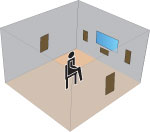 One of the most important things to consider when shopping for in-wall or in-ceiling speakers is where you're going to place them. The guidelines below can help you get a speaker setup that sounds good and works with the build and design of your room.
Placement for home theater
These guidelines will help you get as close to ideal as possible. Not every tip will apply to every system. But the more you can implement, the better your system will sound.
In general, try to place speakers at least 2 feet away from corners and other surfaces that might interfere with or reflect sound, such as tall or bulky furniture.
In-wall speakers in 5.1 and 7.1 systems:
- Place the front left and right speakers so that they're at or slightly above ear level when you're seated, both equidistant from the main listening position. If the speakers are in a wall that's 10 feet from your chair, place them no more than 10 feet and no less than 5 feet apart from each other to maintain a good stereo effect.
- Place the center channel speaker so that it's at ear level when you're seated. If your television is wall-mounted, place the center channel speaker slightly below. If your TV rests on a stand or table, place the center channel speaker just above it, and angle the tweeters down towards seated ear level if possible.
- Place the surround speakers above seated ear level (as high as standing ear level). If the rear surround speakers are placed at seated ear level, they will overwhelm the sound coming from your front speakers, resulting in muddied and inaccurate surround sound. However, if your system will incorporate Dolby Atmos® surround sound, we recommend placing all in-wall or on-wall surround sound speakers at seated ear level to ensure optimum Atmos height effects.
- For Atmos home theaters, Dolby recommends using four ceiling speakers, with one pair located in front of your listening position and a second pair behind it.
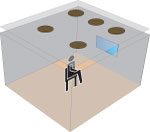 They also suggest using in-ceiling speakers with a wide dispersion pattern, or speakers with aimable drivers that can be angled slightly toward your listening position. If your system can only accommodate one pair of in-ceiling speakers, mount them slightly in front of where you’ll be listening. Don’t worry if your speaker placement isn’t perfect, your Atmos-enabled receiver’s auto calibration system will help dial in the sound for optimum performance.
| For a 5-speaker setup, the right and left surrounds should be to the right and left side of your main seating position. |
| For a 6-speaker setup, the center back speaker should go directly behind the main listening position, in line with the front center channel speaker. It should be about as high as the left and right surrounds. |
| For a 7-speaker setup, the two additional back surround speakers should be placed behind the main listing position, at equal distances from the main listening seat, and about half as far apart as the right and left surrounds. They should be about as high as the left and right surrounds. |
In-ceiling speakers in 5.1 and 7.1 systems:
- Place the front left and right speakers at an equal distance from your main listening position, in front of your TV, about 2-3 feet away from the wall. If the speakers are 10 feet from your chair, place them no more than 10 feet and no less than 5 feet apart from each other to maintain a good stereo effect. Measure the distance from the speakers to your chair in a level, horizontal line — i.e. don't measure upwards from your seat to the speakers in the ceiling. If your speaker's tweeters can swivel, aim them towards your seating position.
 This can help create a realistic soundfield — you'll be able to hear objects on the screen as they move from left to right.
 - As you're choosing speaker locations, also keep in mind the effects of reflected sound. Even if you angle the tweeters toward you, you'll still hear the sound that's reflected off the wall behind the speakers. Ideally, that reflection should be at the same level as your TV screen. You can figure out how far away from the wall you should place your in-ceiling speakers by using a mirror. Mark the spot on the ceiling where you think the speaker should go, then sit in your favorite listening position. Ask a helper to hold a mirror up to the wall, moving it up or down until you can see the mark on the ceiling reflected in the mirror. That's where the sound will reflect off the wall. If the speakers are too close to the wall, the reflection will be too high; too far away from the wall, and the reflection will be too low. In some setups, you may find that you prefer to aim the tweeters directly at that spot wall to get more reflected sound. If your in-ceiling speakers have that feature, experiment with aiming your tweeter before you put the grille on.
- Place the center channel speaker right in the middle of the front left and right speakers. Also aim its tweeter (if possible) directly towards your seating position.
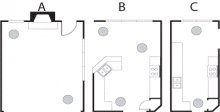
- See the images below for placement of surround speakers in 5-, 6-, and 7-speaker setups. If you have aimable tweeters in your surround speakers, you'll generally also want to aim those towards your seating position. You may also position these speakers closer to the adjoining wall than the front speakers. The sound will reflect off of a higher point on the wall, which is generally desirable for surround speakers.
- A Dolby Atmos surround sound system incorporating only in-ceiling speakers is not recommended.
| For a 5-speaker setup, the left and right surrounds should be to the left and right of your main seating position, as far apart as your front left and right speakers. |
| For a 7-speaker setup, the rear left and right surrounds should be placed behind the main listening position, at equal distances from that seat. They should be about half as far apart as the right and left surround speakers positioned on the sides. |
Related posts:
 This cozied-up formal dining room is wonderful for those who have a large family or group of friends and often find themselves throwing dinner parties or hosting…
 It doesn t matter if you hired the best DJ ever, you re bound to have a handful of wedding guests that want to enjoy the festivities as far away from the dance floor…
 “Have nothing in your houses that you do not know to be useful or believe to be beautiful.” – William Morris I have lived most of my life in a cluttered home. Closets…
 Steps Part 1 Arranging Furniture Determine the function of the living room. Take some time to think about the main function of the living room. Do you have kids…
 Beanbag chairs are coming back in a big way. Think furniture that supports the way of life that you and your kids want to enjoy. Your kids can lie back and do homework…
 @21: Home Despot: the incorporeal form that manifests in ur living room every tuesday to reconfigure the layout of ur furniture
 @Ashlyn: Got a layout planned for the living room and furniture picked out 😊 it's going to be SO perfect.